Saturday, 13 April 2013

Qatar


Home 2008-10; Burrda.


Qatar and football didn’t really go hand in hand for most people until recently, which isn’t really surprising.  The game was only brought to the Arab nation in the late 1940s, when foreign workers arrived to seek their fortune in the oil-fields there.  There were attempts at setting up a governing body to oversee competitions but it wasn’t until 1960 that the F.A. was founded formally. A league came into being soon after, but the Qatari F.A. only became affiliated to FIFA in the early 1970s, almost ten years after the first Qatari national league was set up.  So after a decade of league seasons, the first official league season didn’t kick-off until 1973.

Since then, Qatar's involvement in international football has been somewhat controversial at times.  Firstly, the liberal use of naturalisation rules has led many foreign born players being fast-tracked to full citizenship in order to play for the national team.  While this is not isolated to Qatar, it is more glaring in this instance due to the strict conditions for citizenship that are flouted, in comparison to a “normal” foreigner who lives in Qatar.  Also, in other countries, such as Ireland, it is the “grand-parent rule” that is usually taken advantage of the get a foreign born player on the books.  In Qatar, little or none of these players had a connection to the country before moving to play club football there.  It should be noted, that the wider Gulf region is experiencing a similar development.

The major controversy however, is the awarding of the 2020 World Cup to the country.  There has been numerous accusations of corruption in the awarding process.  In simple terms, it would seem that Qatar is not suited to hosting such a tournament due to political, climatic, environmental, human rights and social justice reasons (it would be easy to add in their lack of international football pedigree, but I personally don’t think that is an issue in hosting a good World Cup).  On the other hand, they have an awful lot of money.  FIFA seem to like money.  FIFA have awarded Qatar the tournament.  Not exactly difficult to see why the conspiracy theories took hold.

Qatar’s only success to date comes in the form of  Gulf Cup wins in 1992 and 2004; and they took gold as hosts at the 2006 Asian Games.  The 1980s were something of a golden period for the team, setting and equalling their ‘biggest win’ records of 8-0 against Afghanistan and Lebanon respectively.   The u-20 team famously reached the 1981 Youth World Cup final against Germany, having taken care of Brazil and England en route. Three years later Qatar qualified for their debut Olympics appearance.

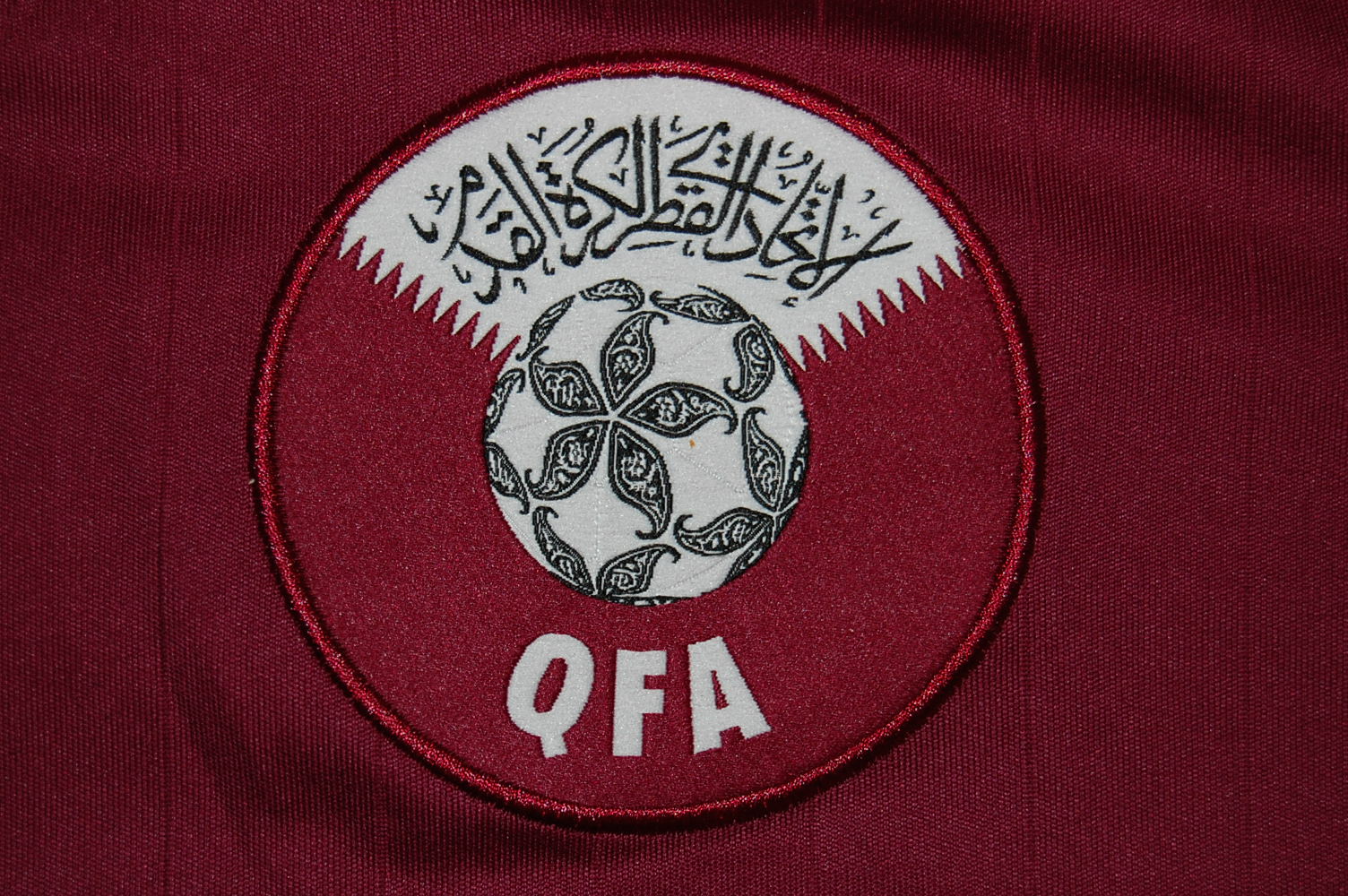
Turning to towards the shirt, it is unique I believe in being the only maroon home shirt in international football.  The away version flips the colours and looks really nice too, but I just had to go for this one.  It is made by Swiss company ‘Burrda’, who have made some recent moves in boosting their profile in football and rugby across Europe.  Most notably in international terms is their taking over from Nike as suppliers to the Belgian national team, and they also supply Tunisia. This shirt features a nifty pin-stripe styling, as well as a nice ‘old-school’ floppy collar.  While the Burrda logo is a bit strange, there is no denying that the Qatar FA’s crest is one of the best around.  It makes great use of the national flag, with some very impressive looking Arabic writing.  Not being an Arabic speaker, I’ve tried to research what it says but have failed apart from an unconfirmed suggestion that it simple says “Qatar Football Association”.  If anyone can help, please feel free to contact me.  In the centre, is a rather snazzy football design that you can see in the pictures below.  All in all, in an age where many Fas are getting in graphic designers to butcher traditional crests and logos, there is something strangely reassuring about Qatar’s.

As a point of interest, I will add a very small piece of Qatari history here that I was not aware of until putting together this post.  In 1995, the then the Emir of Qatar, Sheikh Khalifa bin Hamad al-Thani, went on a little trip to Switzerland.  He left his son, Crown Prince Sheikh Hamad bin Khalifa al-Thani, in charge of running the place while he was away.  The only fly in the ointment was that the Crown Prince was ready to oust his father in a coup, and he struck during his father’s absence and claimed the throne with the support of the majority of the rest of the family.  Snr claimed at the time that he would return and claim it back, but when other nations, including the USA, began to recognise the new Emir as the legitimate ruler, the game was up.  He has since returned, but I imagine Sunday dinner remains awkward.


Tuesday, 2 April 2013

Singapore


  Away 2001-07; Tiger.

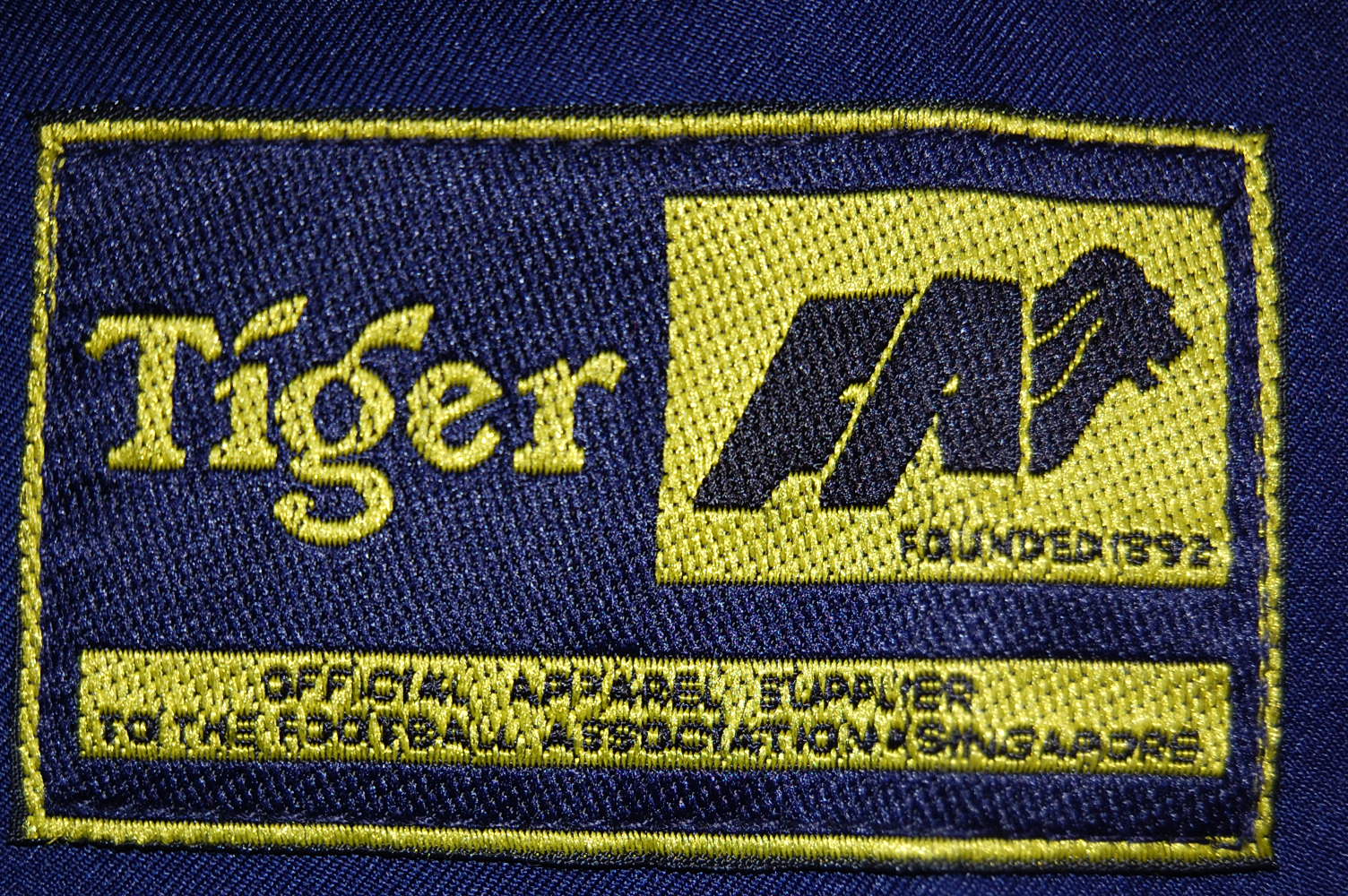
OK, the first thing you might have noticed with this one is the manufacturer.  You would be forgiven for writing this one off as something a beer company gave out as a bar promotion, but no, the Singapore beer brand ‘Tiger’ actually supplied this kit.  And what’s more, it wasn’t just a once off gimmick; it is actually probably the longest running kit any country has used in modern times.  Singapore wore this (and the same template in red as a home kit) between 2001 and 2007.  In a time where the bigger nations are revealing a new kit every year, with special kits for different tournaments and anniversary games, Singapore bucked the trend impressively. 

The question you might now be asking is “why?”.  Well to the best of my knowledge, Tiger were looking for a way to get around FIFA shirt advertising rules.  So they joined up with Diadora to produce this shirt.  From there on in, every time Singapore played, Tiger got their logo beamed into thousands of homes and into many newspapers.  That is the kind of clever thinking I like.


As for the shirt itself, well it is a real throwback in terms of quality.  The inner label says '100% polyester microfibre', but it feels more like heavy linen than a sports performance shirt.  From researching it, it seems that the version I have is actually a “player issue” shirt, as it does not feature an additional large ‘Tiger’ logo on the chest as some of the others do.  By normal standards, as a ‘player issue’ shirt it seems quite heavy considering the heat they players would be expected to play in.  That said, there is a full mesh underarm which has a lovely 5 star design based on the Singapore flag, which is also used as the crest here (Though the nifty F.A. logo does feature on the lower right label on the shit). For something so simple, I really do like the stars under the arm as a design feature.  The quality of the shirt is fantastic, it must be said, and is almost closer to a rugby shirt in terms of the reinforcement on the seams for example. All in all, this is one of my all-time favourite shirts in terms of design, and the story behind it just makes it better.


In footballing terms, Singapore are reining AFF Suzuki Cup holders (funnily enough, this was previously the Tiger Cup as it was sponsored by the aforementioned beer company).  This is a regional tournament played out between countries from South East Asia by that region’s governing body, the ASEAN. This is Singapore’s fourth title, and makes them the tournament’s most successful team.  Apart from that, success has been thin on the ground.  This is in part down to a mixed attitude towards the national team in the past.  While the official national team played in international competition, a representative team played in the Malaysian league and cup.  This selection, which included some foreign-born players, was quite successful and at times overshadowed the official team.   That was until 1996, when the F.A.S. removed teams after a row over money (isn’t it always?) and the professional S-League was set up.  

Unfortunately (in my opinion at least), the national team is now kitted out in generic Nike gear but this shirt will always remain as testament to a quirk of international football shirt history. 


I must thank Matt for getting this shirt to me and apologise publicly in the delay in getting my swap to him. 


Saturday, 9 February 2013

Burkina Faso


Home 2012/13; Puma

Burkina Faso football shirt

Like the Gabon and Algeria shirts from this collection, the Burkina (as the country is often shortened to) shirt was initially released for the 2012 ACN and used again at the current ACN in 2013. Also like the other shirts in this range, it was designed by a local artist, this time the honour falling to Saïdou Dicko.  The graphic on the shirt is taken from the FA's crest, which in turn has burrowed the two stallions form the country's coat of arms.  This also lends itself to the teams nickname, 'The Stallions'.  Strangely, many of the shops selling this, are selling the version that featured no crest, but did have the watermark graphic, making for quite an odd looking shirt. On the matchworn shirts, the national flag was often placed under the crest.  So that leaves three different versions of this shirt that have been produced.  It is a very nice shirt, in my opinion.  I'm quite fond of the shade of green used here.  In terms of cut and shape, it is quite tight fitting but nowhere near as tight as the player versions. Thankfully.  Interestingly (or not), the back of the neck on this template has also been used by Puma for some of their rugby shirts, including Ireland's.

Burkina's greatest moment on the international stage is developing as I write.  They have reached this year's ACN final, to be played tomorrow (Feb 10th).  Previously, a fourth placed finish as hosts in 1998 was their greatest achievement.   They have never been to a World Cup.

Burkina Faso was previously called The Republic of the Upper Volta, but the name was changed in 1984 to include words from the two main local dialects. "Burkina", from Mòoré, may be translated as "men of integrity", while "Faso" means "fatherland" in Dioula. "Burkino Faso" is thus meant to be understood as "Land of upright people" or "Land of honest people". Inhabitants of Burkina Faso are known as Burkinabè.  

Burkina Faso football shirt


Burkina Faso football shirt


Burkina Faso football shirt


Burkina Faso football shirt


Tuesday, 5 February 2013

Republic of Ireland (2)


Home 08-10; Umbro.


Ireland Football Shirt

I have already written about one Ireland shirt, so I won't go into much here.  This is from 2008-10, a time most notable in Irish football history for Thierry Henry's famous handball and William Gallas' subsequent goal that knocked Ireland out of the WC 2010 play-offs.  It is fair to say that the country lost the run of itself in the days that followed, with calls for boycotts of French holidays and goods, as well as diplomatic moves to get the French or FIFA to award a replay.  They didn't of course, and the French went on to fall apart in South Africa. If you believed in such a thing, you might call it karma.

This shirt itself is quite nice, but I do wish the Umbro logo and FAI crest were symmetrical.  Apart form that, the flashes of white and orange down the sides are a nice nod to the flags colours.

Ireland football shirt


Ireland football shirt

Ireland football shirt


Ireland football shirt

Ireland football shirt